

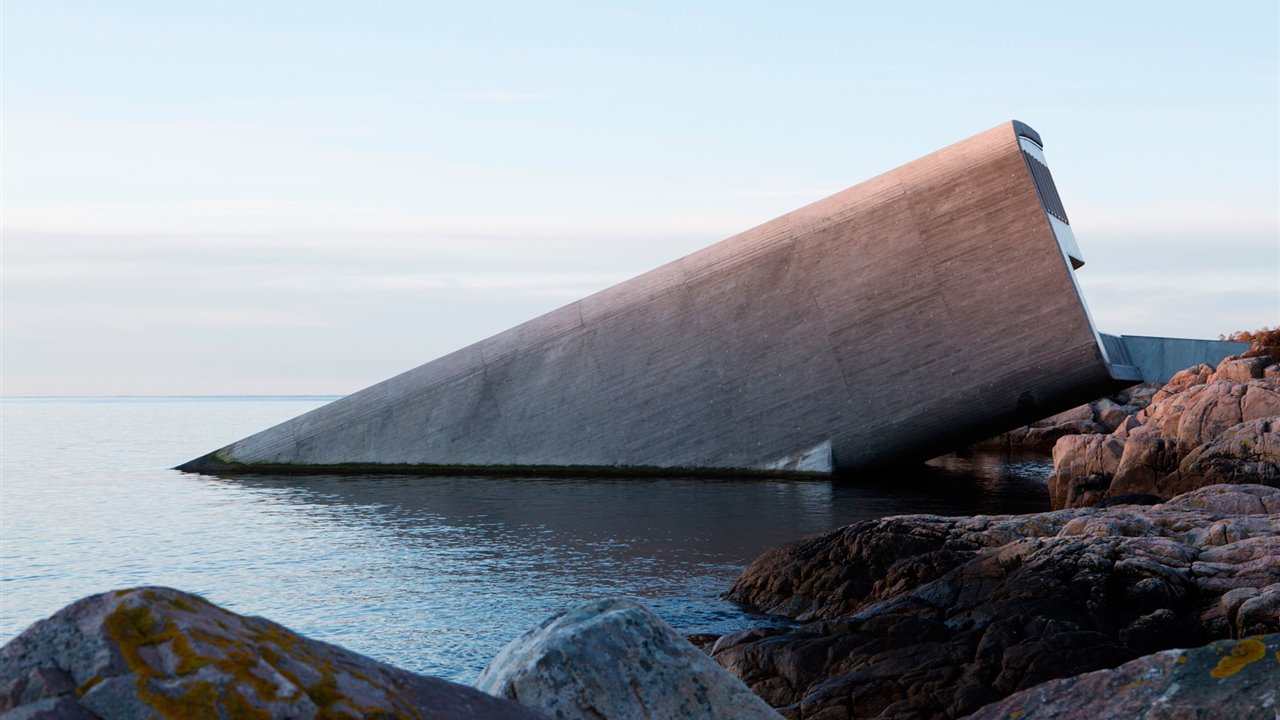
On April 2, the first underwater restaurant in Europe will open its doors . In addition to having become an architectural feat signed by the Snohetta studio and being a gastronomic space whose menu will be based on the flora and fauna of the southern coast of Norway, Under will be an observatory of local underwater biology.
Behind the project, which began to take shape in 2015, are the Ubostad brothers, fourth generation of a family of hoteliers who have wanted to build a cultural icon: a restaurant that puts this area of the country on the global map of great gastronomic proposals and with which to revitalize a region whose charm revolved exclusively -at least until now- in around a great lighthouse and the fury of the sea that surrounds it.
Architecture and landscape
If one reviews Snohetta ‘s curriculum , one will see that her creative philosophy is based on fusing architecture and landscape. And in that sense, Under is probably the most radical design of hers. In the words of Kjetil Traedal Thorsen, founder of the studio, it is a project with “enough muscle to resist the forces of a violent nature.” For this reason, concrete is the material with which its structure has been made. One meter thick with which to defend against a hostile environment marked by sometimes virulent waves and wind. A true milestone with which this study celebrates its 30 years of life as a team.
Return to origin
With this restaurant, the experience of eating underwater has not only been sought, watching the underwater life on the other side of a giant glass 11m long and 3m wide . Much more than that, Under speaks of man’s primary relationship with the sea, of essential and primordial links. “Humans are made up primarily of water. Being in the restaurant will take us back to our roots,” says Craig Dykers, co-founder of Snohetta. “For us – Thorsen continues in statements to National Geographic Travel – architecture is the art of prepositions. It all depends on how your body relates to the world. And in this case, it is done from below”.
Plated wood
Along with concrete, wood is the other main element. Made of local oak, we see it in part of the exterior façade, in the route of the different interior spaces, in the furniture and in the brutalism of the plating. An element that has also been conceived by adding stones, pebbles and sand from the shore. We are talking about an attempt to bring Norwegian geography to the environment of the plate. A scenic design consistent with Under’s discourse: that the landscape be the essence of the restaurant itself.
Succulent biodiversity
Behind the stove is Nicolai Ellitsgaard. At only 32 years old, this head chef has been conceiving a menu based on products from southern Norway for more than two years. For Under he has developed a menu of 18 dishes based on local biodiversity. Barnacles, algae, snails or crabs are investigated to offer the diner a unique experience. An experimental gastronomy that takes the taste of the sea as its starting point and arrival point and in whose referent are locals such as the Danish Noma.
Constructive wonder
The building process was really complex. “We had a lot of trouble,” says Craig Dykers, “finding a shape that would make sense of the building’s function and at the same time hold its own against the forces of nature.” Finally, the team understood that the correct path was the straight line. A gently curved straight line with which to design a concrete tube through which diners can descend to 5 meters below sea level. The construction of Under was first done on the surface. Later, it settled on the sea. And as a floating structure, it was filled with water to sink it and finally anchor it to the sea floor.
More than an observatory
Marine biologist Trond Rafoss has worked with the team from the beginning. His work has consisted of investigating in greater depth the life in the waters of the area. Flora, fauna, photosynthesis processes or temperature changes according to the seasons have been (and are) a reason for observation… And all this with one objective: to promote an active ecosystem in the immediate vicinity. In other words, turning Under into a reef that fosters marine life in front of that large window: that gigantic eye of Sauron that illuminates all space with a soft blue tone.
A rock on a rock
As a constructive reference, Snohetta had in his sights the abandoned bunkers on the country’s coast after World War II. For Rune Grasdal –architect and studio manager- they are an example of how concrete has the ability to merge with its environment. Because that is what Under is intended to end up being just another rock on the Norwegian coast: a giant concrete rock that sinks into the cold North Sea, which will be eroded by the wind and waves and which will gradually take on the same chromatic tone. than the large stones that mark the steep coastline of Lindenes.
Growing old with the landscape
“We have tried to unite the building with nature –says Thorsen- and after a few years it will be more and more integrated into it. On one side of the glass, all the biodiversity of the area, and on the other, the human beings who visit the restaurant”. That is why this monolithic concrete tube actually functions as a giant rock that could be walked on and from which to contemplate the changing rhythm of underwater life. Something like what James Turrell did with Roden Crater (Arizona) or what they didn’t let Chillida do in Fuerteventura, and with the same ethical discourse: talk about man’s relationship with the elements. “The idea: to grow old with the landscape, not against it,” concludes Thorsen for National Geographic Travel.


