


A few miles from the Biscayan coast, the encounter with these animals, which arouse fear and passion in equal parts, is guaranteed
The sky has turned gray and the wind is starting to blow harder. The group, exhausted by the swaying of the waves after two hours in the waters of the Cantabrian Sea, and several miles from the coast , try to get on the boat. With bare feet, after removing their flippers, they try to access the metal ladder and, at that moment, a two-meter-long blue shark lurks just inches from their ankles .
Twelve years earlier, Isaías Cruz , a Pamplona passionate about the sea, decided to go in search of sharks . For a time, he was in contact with the fishermen of the Basque Country gathering information. He knew that this area was a breeding habitat for some species such as the blue shark . After a period renting boats and touring the coast to France in search of the best place to interact with them, he found a key point on the edge of the continental shelf . It was the place he was looking for and where in the summer specimens, especially young ones, of blue sharks, better known in our waters as blue sharks, and to a lesser extent, mako sharks, also called mako sharks, are concentrated.
From then on, he began to visit the area with friends to learn about the behavior of these animals, until in 2013 he decided to share his experience and create Mako Pako, the first shark sighting tour operator in our country and in continental Europe service offered through its website or destination activity agencies such as Civitatis. From the beginning, he is clear that his work is not just tourism, but rather focuses on a much more complete experience, aimed at raising awareness and protecting this vulnerable species.
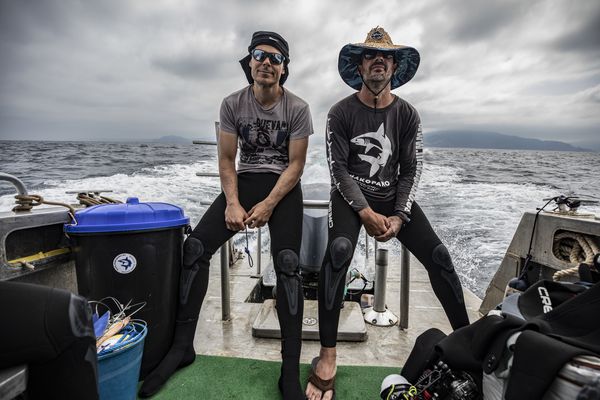
Txabi Mina (left) and Isaías Cruz on the stern of Mako Pako’s boat
In the port of Bermeo, a town with a seafaring tradition that once held the title of Cabeza de Vizcaya , a group of eight people combine pinchos with biodramine on one of the crowded terraces during the month of August. The weather forecast forces events to come forward. The port car park becomes the base of operations. Wetsuits, diving masks and cameras are piled among the cars. Juandi Alcázar, diving and freediving instructor, coordinates this group made up of freedivers who regularly train with him. He is also passionate about sharks, he has worked as a guide in destinations such as the Red Sea or the Maldives and he is clear that the only way to protect them is to get to know them up close.
The Martillo dock is packed with bathers and families who seem to find rest on the burning concrete. Miguel and Álvaro parade among them stuffed in the apnea suit to jump into the water and relieve the heat before boarding.
Isaías waits at the port. He is a serious guy and doesn’t mess around. He likes what he does and if you hesitate he will give you a smile but he is not a catamaran entertainer. After signing some forms, we boarded. He is accompanied by Txabi Mina , a partner of Isaías since the project took shape. He has a degree in Marine Sciences and is a marine biologist and spends a large part of the journey explaining to the group what the activity consists of and throwing out some data: 30 tons of blue sharks are fished every day in these waters, “even so, sightings have been maintained during these years or have even increased’.
After 45 minutes of sailing, the boat stops and the two coordinate perfectly in the ritual that will attract the sharks using bonito heads and blood from a bucket that seems to have no bottom , while some take the opportunity to take a nap rocked by waves. An hour later, Txabi shouts “Shark, and it’s one of the big ones!”, while a fin cuts the surface of the sea. In the imagination of most mortals, this would be the signal to get away from any area with more than an inch of water. This is how Spielberg taught us, but everyone is eager to jump into the sea.
Like blue ghosts
A security line several meters long acts as a border and guide for the first few minutes and, shortly after, like blue ghosts, the sharks arrive. It doesn’t take long for humans and sharks to gain confidence and start the dance. Andrew is lost at the bottom between long apneas while Cristina records with her camera at a shallow depth. The current forces us to be alert at all times so as not to be dragged away from the boat, and every minute that passes the sharks are more confident and their parade is closer, even brushing us. Up to 11 specimens have responded to the call and are stalking us from everywhere.
A moment is enough to forget the reputation and focus on the beauty and elegance of an animal that arouses both fear and passion. Juandi dives armed with a powerful spotlight and the rough, bright blue skin of the shark contrasts with the darkness of an abyss that goes up to 200 meters deep. Suddenly, a school of tuna and a group of dolphins go on a date that turns wonderful and wild.

Two blue sharks swim in circles under the divers.
As evening falls, the sea worsens, and exhausted, we approach the ship. The sky is gray and the wind is blowing hard. It’s time to return to port, and one by one we climb the metal ladder, while a two-meter blue shark, with a sharp snout and eyes as round and black as night, approaches a few centimeters from our ankles without anyone it bothers you.


