Imposing, majestic, impressive and unchanged over time, that’s how castles are. Fortresses whose walls had the mission of safeguarding princesses, kings and warriors, and where epic battles that went down in history took place. Some believe that they are inhabited by the spirits of their inhabitants but, for others, they are simply wonderful fairy tale places.
Europe is full of medieval buildings that are worth a visit, but the list is endless, that’s why the search engine for flights and hotels, Jetcost, has asked its users to select the most dazzling ones for different reasons . They have been limited to 20, although there could have been many more, and five of them are in Spain . Do you know which ones they are?
Belmonte Castle (Cuenca)
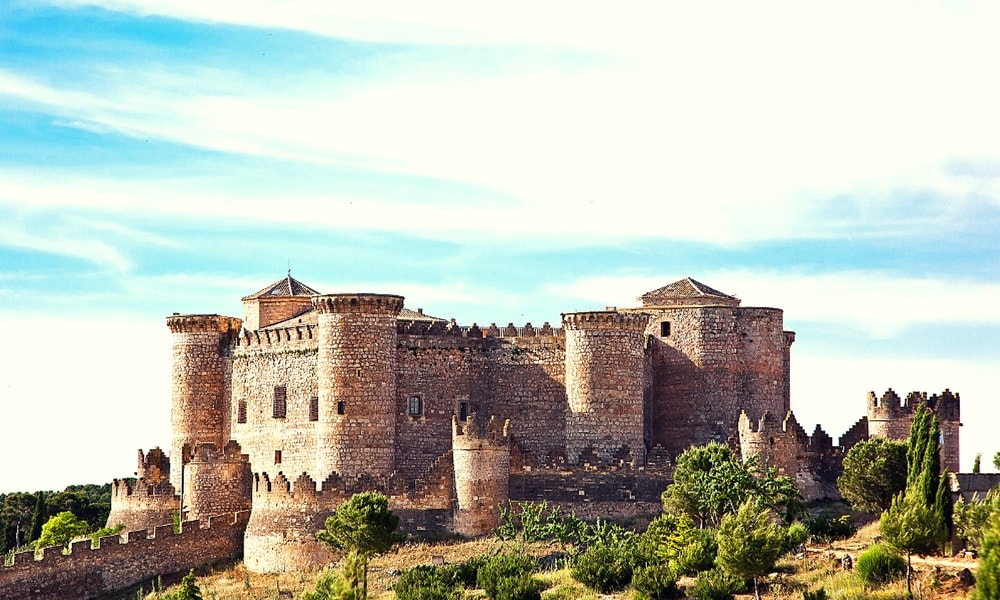 Belmonte Castle, Cuenca
Don Juan Pacheco , Marquis of Villena, was one of the most influential noblemen in the kingdom of Castile during the reign of Enrique IV. The Marquis undertook to build a fortress in the town of Belmonte , in 1456 , on the hill of San Cristóbal, and he did so. Later, in 1857, Eugenia de Montijo , Empress of France , was renovated in a neo-Gothic style, although rooms, galleries, the chapel, and several original Gothic-Mudejar arches have been preserved.
The outer enclosure is walled and is pentagonal, and joins the walls that descend to the town of Belmonte. The parade ground is an equilateral triangle and the rest of the building develops from it. The shape of the castle is a six-pointed star and at the end of each of them there is a cylindrical tower, in addition to the keep.
In the basements are the dungeons that can still be seen, and inside the various rooms are shown in great detail, where it is possible to imagine what life was like for its inhabitants.
Peñíscola Castle (Castellón)
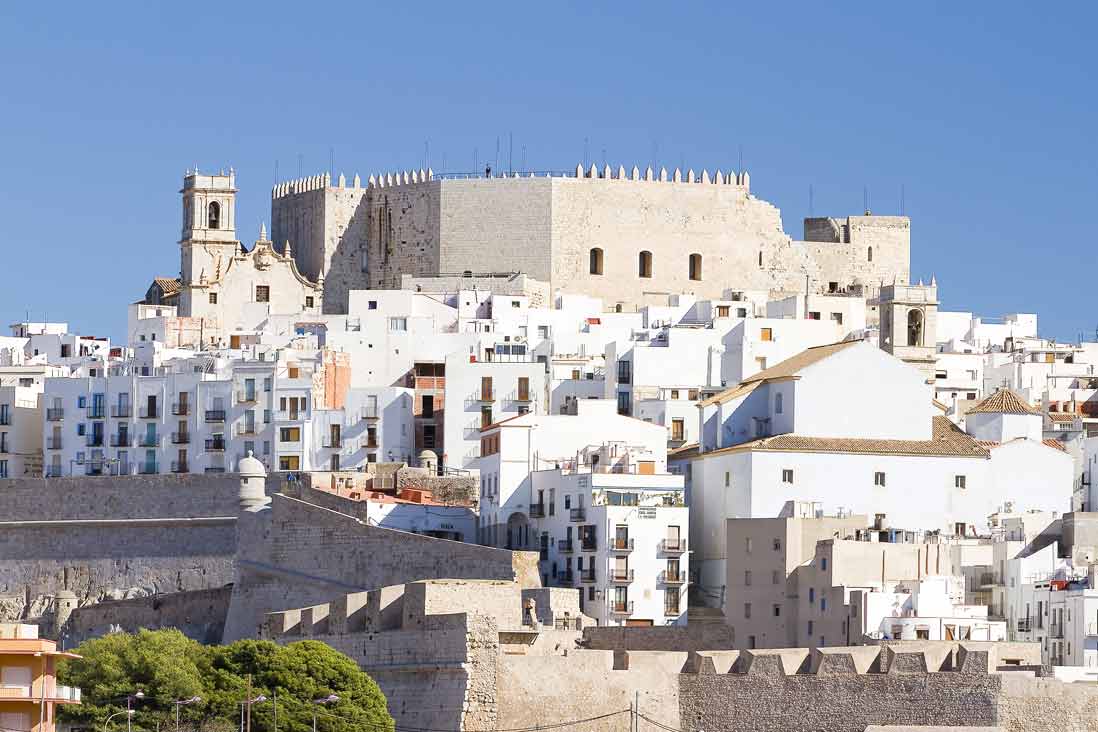 Peniscola Castle, Castellón
Peñíscola Castle is a fortress that occupies the highest area of the rock on which the ancient city is based. Construction began in 1294, and it was completed thirteen years later, in 1307. Its patrons were the Knights of the Order of the Temple . It has the peculiarity of having been a papal seat, one of the three that have existed throughout history, where Benedict XIII was confined.
Gothic in style with a marked Romanesque character, it is austere and sober like the Templars themselves. It has a perimeter of 230 meters and an average height of twenty meters, and is located 64 meters above sea level. The castle was built with carved stone walls and most of the rooms are covered with barrel vaults. Later, in the times of Felipe II, in the 16th century, the architect Juan Bautista Antonelli incorporated an artillery park and stronger walls to resist pirate attacks.
Bellver Castle (Palma de Mallorca)
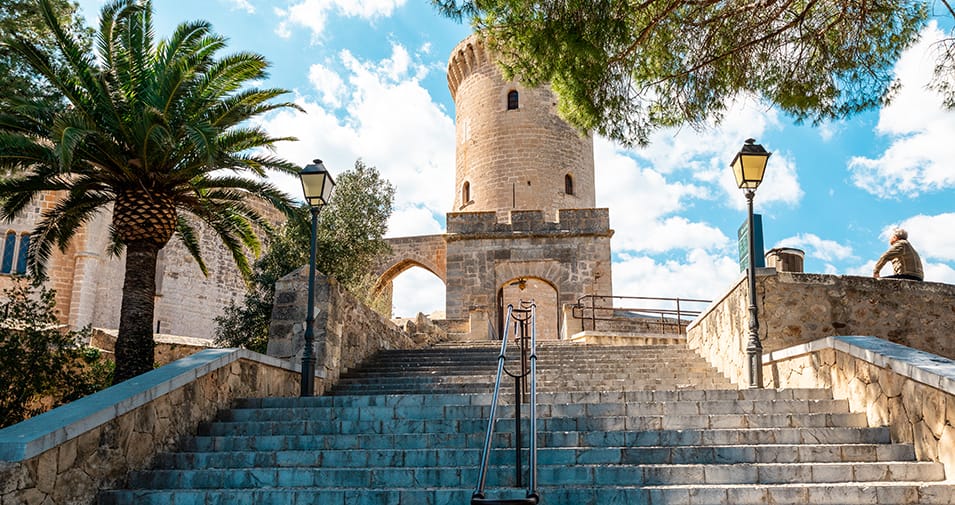 Bellver Castle, Palma de Mallorca
Located on a hill, 120 meters high, Bellver Castle offers spectacular views of the entire city. It was also conceived as a palace-fortress where the rulers could safely take refuge in case of danger. It was built between 1300 and 1311, by order of Jaime II , the work of the architect Pere Salvà. It is said that it could have been inspired by the Monte castle in Naples, which has an octagonal shape.
The construction consists of a Gothic-style building with a perfectly circular floor plan (something quite unusual), which is organized around a central courtyard, also circular, with four large towers, one of them, the so-called main or homage tower, which is separated from the building and joined by a bridge, while the rest of the towers are embedded in the main body. Inside the castle there is a two-story circular parade ground and a patio built on a cistern. On the second floor there is a chapel.
From the War of Succession (1700-1715) the castle became the main political and military prison on the island, as in the Spanish Civil War. Since 1976 it houses the City History Museum.
The Alhambra of Granada
 Views of the Alhambra in Granada
The Alhambra is a set of palaces, gardens and defensive fortress with almost 105,000 square meters inside and completely walled, 1,730 meters of irregularly shaped wall in which thirty towers of very different size and function are distributed. It was conceived between the IX-XII centuries by the Nasrid monarchs . Most of the buildings that remain belong to Yúsuf and Mohamed V. In 1492, it became a Christian court after the reconquest of Granada by the Catholic Monarchs.
In the 16th century, the Renaissance-style Imperial Palace of Charles V was added and is now a museum. From the 18th century the Alhambra suffers from great abandonment, part of it being destroyed during the French domination. In the 19th century it was restored, and in 1984 the Alhambra, the Generalife and the Albaicín neighborhood were named a World Heritage Site.
A paradise in Granada richly ornamented with plant motifs, the arches are decorative, and the walls are covered with ceramics or plasterwork. Don’t miss the Alcazaba, the royal palaces, the Generalife gardens, the Golden Room, the majestic Comares room, the Renaissance palace of Carlos V and the famous Patio de los Leones.