It does not matter if you are Muslim, Christian, Jewish, or even atheist, beauty does not understand religions. Fights, hatred, punishments and expulsions can occur, but when you look at a cathedral like the one in Córdoba, all negative emotions disappear and only one predominates: the most unconditional admiration. This is probably the fundamental reason why this mosque continues to be preserved in such an exceptional state.
It was declared a World Heritage Site in 1984 and an asset of universal value in 2014, which makes it clear that, in some way, it is like entering and passing through the soul of the city. It is where history, culture and art make sense. To understand its magnetism you have to know it thoroughly, observe the details, breathe its conciliatory air. But above all you have to immerse yourself in its interior, and let yourself be carried away by its magic.
Can you guess which are the 15 Spanish World Heritage cities?
Few monuments have withstood the passage of time and the different ways of understanding the world with such dignity as the Cordovan mosque. From the 8th to the 19th century, when the last reforms were carried out, on the banks of the Guadalquivir, this amazing temple has been born, has risen and has matured without prejudice and without losing its essence. It has been quite a feat and, at the same time, a tribute to the complicated exercise of coexistence between human beings.
The current mosque was built in the year 786 on top of an old Visigothic church consecrated to Saint Vincent the Martyr which, it seems, was also built on the remains of a paleo-Christian church. Later, in the year 833 and until 988, it was extended on several occasions in order to accommodate more faithful (up to 30,000 people could attend).  View of the Mosque-Cathedral of Córdoba .
At that time it became the most important mosque in the West – second only to Mecca – and the maximum expression of Islamic art in Spain. In the 16th century, when Islam was definitively expelled from the Peninsula, a Renaissance cathedral was built in the central naves, in the heart of the mosque.
203 steps to the top
The bell tower -old Aljama minaret, whose remains are still visible- marks the identity of the city and the mosque. And he has done it all his life. It has always been imposed on the landscape of Córdoba. Constructive contributions from different architects follow one another, giving it its current appearance. In addition, it is the best way to start the visit: climbing its 203 steps to reach 54 meters high.
In order to enter you have to draw €2, except for those from Cordoba who have free access. But it is very worth it. The ascent is easy, stairs solid and firm and not very narrow. The views are fabulous, the best in Córdoba. From the heights, the Guadalquivir river, the historic center of Córdoba and the magnificent Roman bridge stretch out towards the horizon, appearing like an endless dream.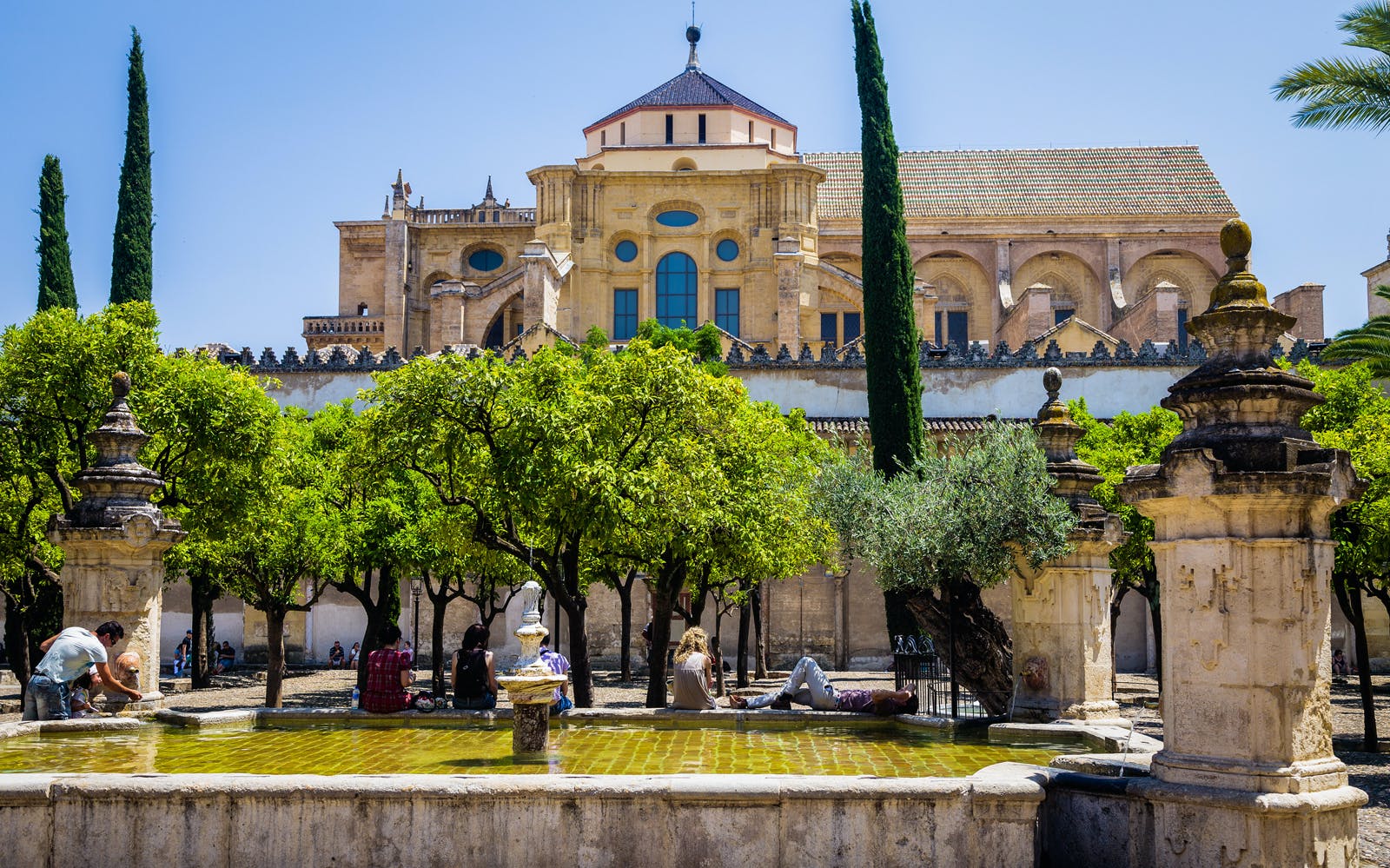 Patio of Los Naranjos and bell tower of the Mosque of Cordoba.
The Gate of Forgiveness and the Patio of Los Naranjos
We can say that the entrance through the Puerta del Perdón (the bishop dispensed forgiveness -hence his name- to the faithful who had not been able to pay the tithe) to the Patio of Los Naranjos is like one of those pleasant aperitifs that brighten your stomach before an exquisite meal. You have to enjoy it slowly, walking, admiring, immersing yourself in its history. This is an old Muslim ablution court that was converted to Christianity in the 10th century, making it larger and more open.
They are 130 meters long by 50 wide and owes its name to the 98 orange trees -planted in a row in the 17th century-, which represent the continuation of the columns of the prayer room inside. At this point we must remember that ablutions were necessary so that Muslims could enter to pray in a state of absolute purity.
Water was essential, which is why you can find two large fountains and three water fountains in the patio. The most outstanding is the Santa María fountain, also called the Caño del Olivo, a Baroque fountain from the 17th century.
The marble forest with 856 columns
Once we dive inside from the Patio de los Naranjos, the first thing we see is the prayer room. It is made up of 11 longitudinal and 12 transverse naves formed by a spectacular “forest” of 856 columns (it once had 1,003) of marble, jasper and granite, joined by 365 double horseshoe arches. The columns and arcades point to infinity in which god dwells according to believers. The forest of columns offers one of the iconic images of the mosque.
Touring this place is a unique aesthetic and emotional experience. As you walk under the arches, the play of lights, colors and symmetrical shapes is extraordinary. White bricks and red voussoirs follow one another almost infinitely as if it were an immense and leafy multicolored ocean. This chromatic diversity is due to the fact that many of these columns are Visigothic or Roman and several belonged to other buildings, which the Umayyads masterfully used for the construction of the mosque.
A cathedral in the heart of the temple
Shortly after the prayer room “the forest of columns” is transformed into a cathedral lady. As I said before, after the expulsion of the Muslims, the Christian kings used the old mosque for religious worship until, in the 16th century, Charles V had a Christian cathedral embedded in the bowels of the mosque. The first stone was laid in 1523, and two hundred years passed before the works were completed. And then it received the name of Assumption of Our Lady.