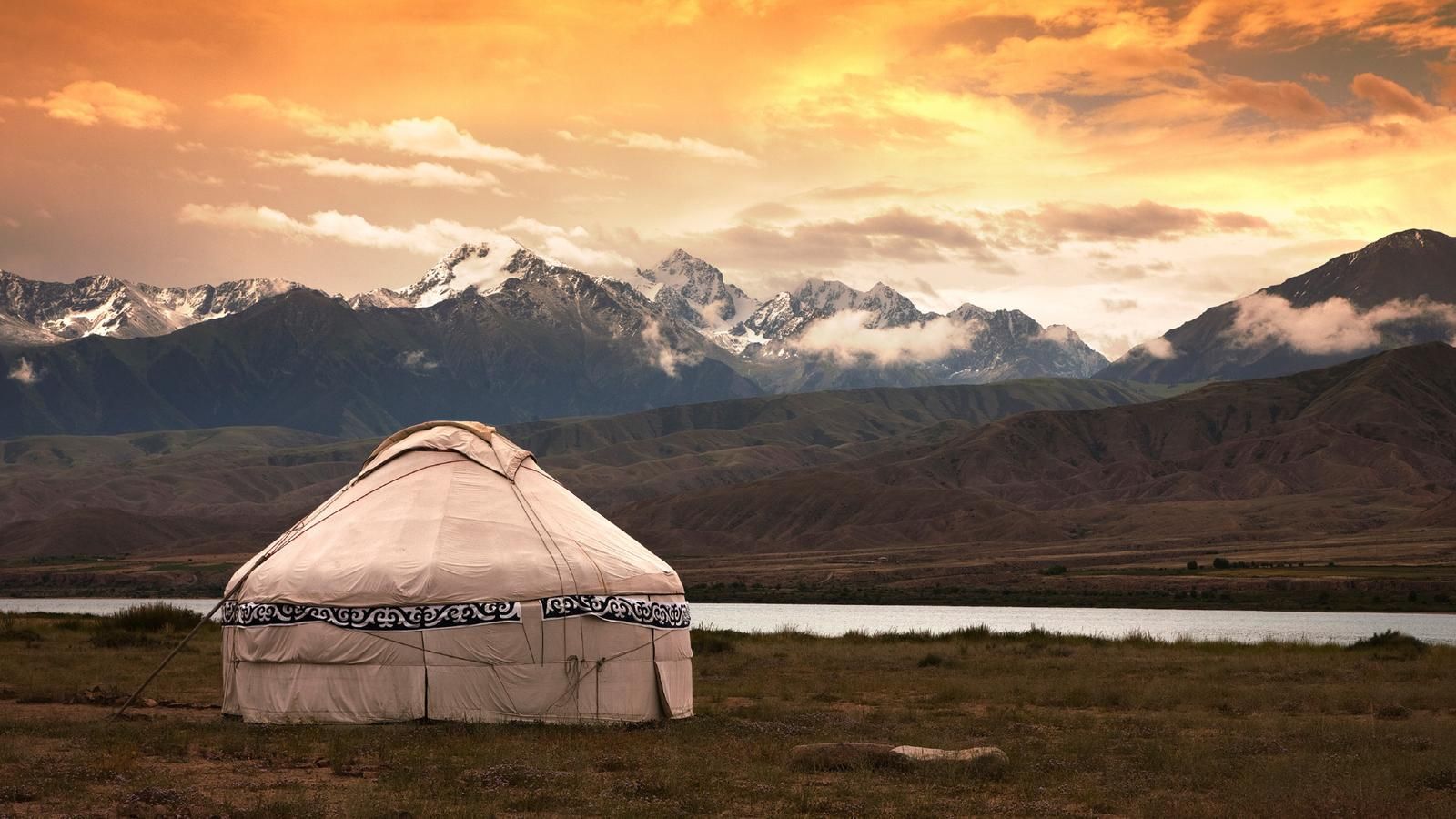
The landscape interest of Mongolia is undeniable. It has it all: snowy peaks, deserts, steppes, forests, lakes, volcanoes… the only thing missing is the sea, but being completely surrounded by Russia and China, the nearest coast is more than a thousand kilometers away.
Instead, it has mountains spread across three distinct mountain ranges . The highest is the Altai chain to the west, whose Juiten peak at more than 4,300 meters is the highest peak in the country. Although it may not seem like much, considering that the average altitude of the territory is about 1,500 meters. That is where its iconic steppes develop , soon dominated by the boreal taiga as by hills of green meadows. Bucolic in appearance but with severe climatic conditions.
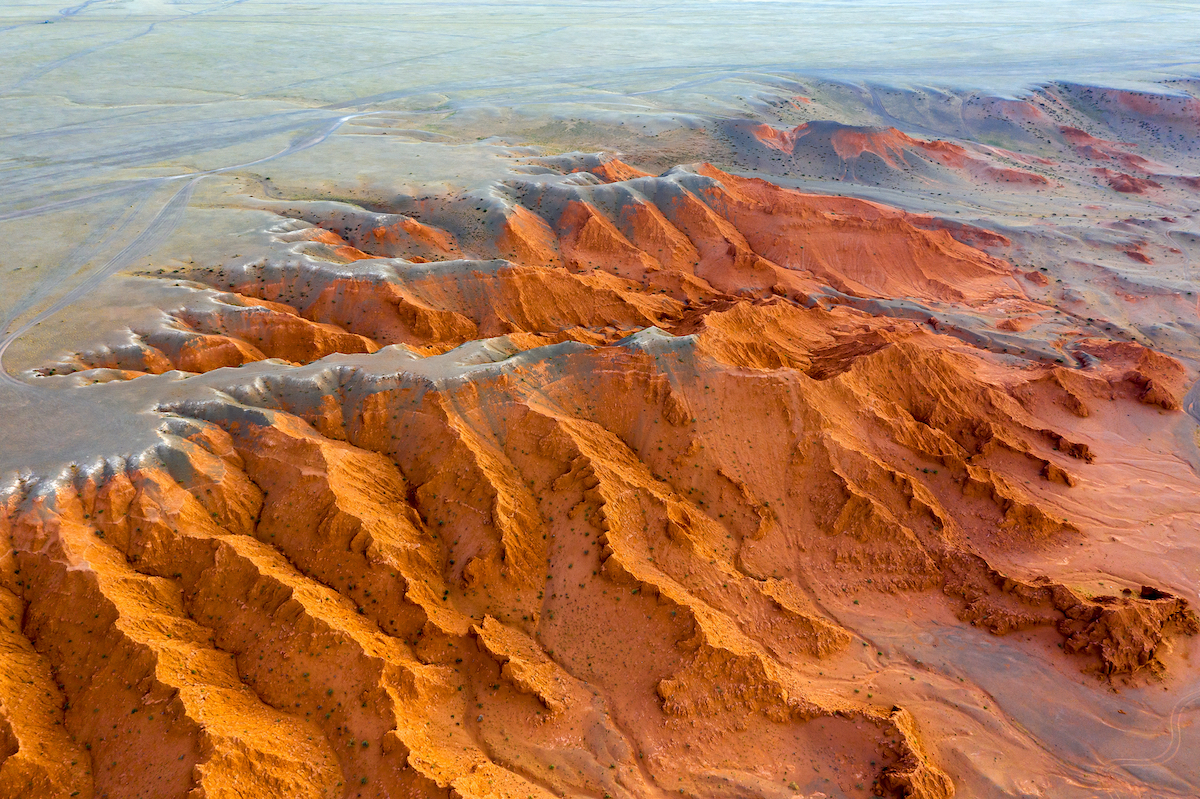 Gobi desert.
They are hard lands, but not the most unpleasant. That accolade goes to the great Gobi desert . A place so inhospitable that even the mythical Trans-Siberian crosses it as quickly as possible. It has the beauty of the wild and keeps countless secrets. Among them, some of the best deposits of dinosaur bones found in the world, such as Flamming Climbs . However, the Gobi can be inhumane, and travelers make only brief forays to places as unique as the cliffs of Bayan Zag or the Singing Dunes of Khongoriin.
We could continue naming amazing enclaves of the Mongolian landscape, such as the salty waters of Lake Jonsvhol or the Khorgo volcano in the province of Arkhangai. We are talking about a country whose surface is more than three times the Spanish territory, full of fascinating natural spaces where the footprint of man is imperceptible for miles and miles.
 Mongolian traditional clothing.
Barely three million people live on such an extension of land . And half are crowded into the capital, Ulan Bator . The rest of Mongolia has the lowest population density on the planet, two people in every square kilometer. And yet, when you return from a trip to these lands of Central Asia, the memory of these people remains more than that of the wonderful landscapes that you travel through.
The great attraction of this trip is to discover a culture that takes us back to another era. To a time of nomads, in which man adapts to nature and not the other way around. While hospitality is not a matter of courtesy but a necessity. And the epicenter of these sensations are the yurts, whose local name is gers.
Yurts
 Yurt camp for tourists in Mongolia.
The yurt is a type of dwelling that has remained practically unchanged for two millennia. It is a circular space created from a wooden structure, on which layers of blankets and tarpaulins are placed, which, in the end, are fixed by means of ropes. Simple and ingenious because these gers are set up and taken down in just a few hours , and they are much more welcoming than they appear.
The interior decoration is in bright colors and the central stove, which is never missing, make winters bearable. While if the heat presses in summer, it is enough to put fewer layers on the cover and even raise its walls so that the air can run.
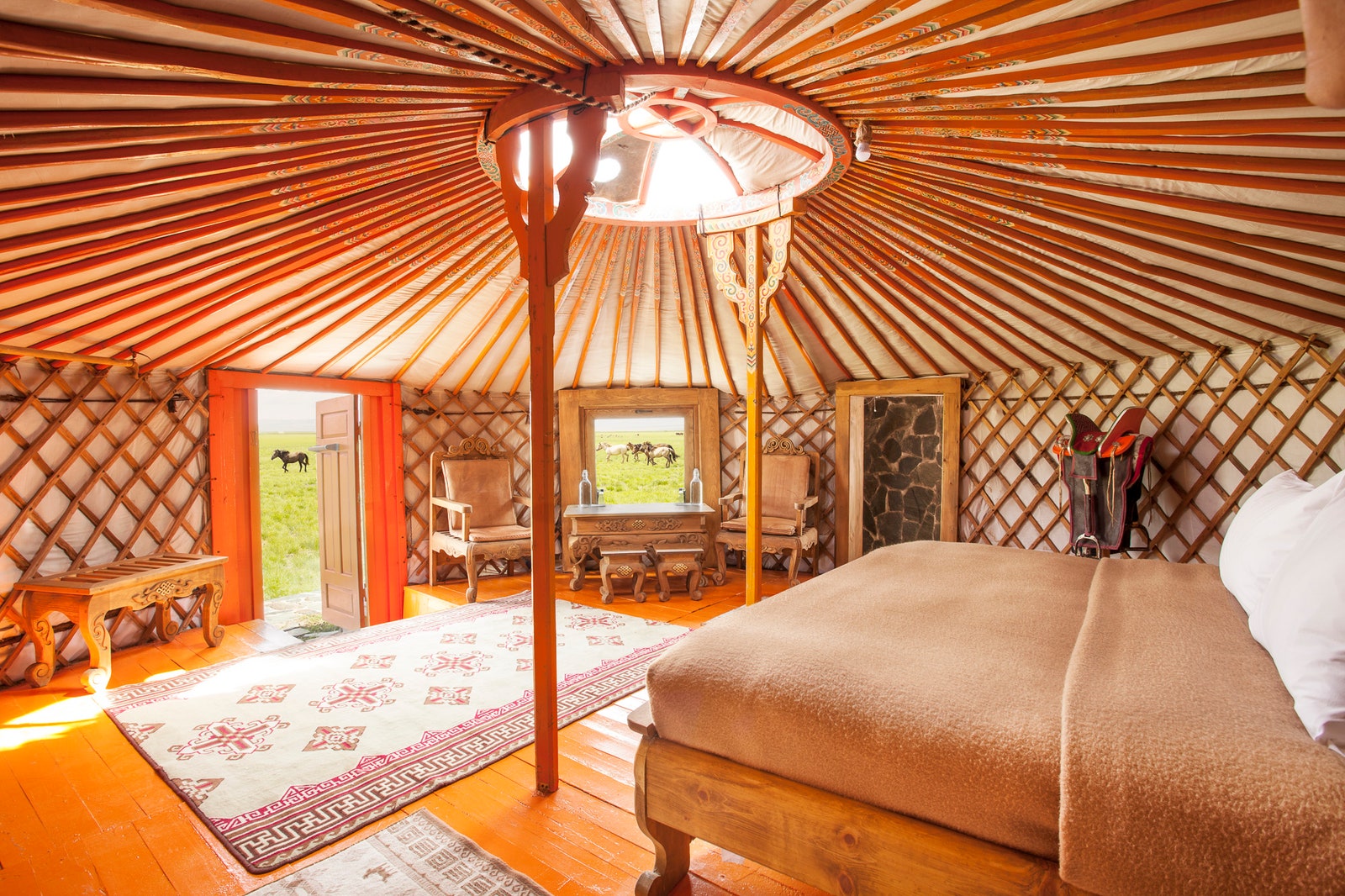 Interior of a tourist yurt in Mongolia.
There are them all over Mongolia, even in Ulan Bator there are entire neighborhoods built on the basis of gers. Although they acquire all their meaning in the steppe areas , where families with herds of horses or yaks constantly move in search of the best pastures.
While many tourists plan their trips based on the paradisiacal beaches and all-inclusive resorts, those who come to Mongolia are looking for a different panorama. It is intended to experience something of that nomadic life that wanders through open spaces. If anyone wants to discover the far horizons of the grasslands of Khustain Nuruu National Park , or photograph the rivers and taiga of Terelj, they have to stay at these gers. There are no hotels, nor would they make sense. However, there are yurt camps built expressly for the arrival of tourists. Although it is also possible to stay with local families. Thus the experience is more complete.
 Milking the yaks.
The austerity and harshness of his life have nothing to do with his smiles and desire to please. If it’s cold, they reserve the warmest place for the guest, or they reserve the space with the best view of the TV. Because it is true that progress and the arrival of foreigners has brought changes in the lives of these people. For example, satellite dishes are already an essential part of any yurt. And although there is no Mongolian who does not know how to ride, it is also true that motorcycles and ATVs take a lot of work out of horses and camels.
 Motorcycles are already part of the landscape in Mongolia.
These are the great little luxuries for these people. For the rest, rural life in Mongolia is governed by ancestral customs , among which there is no lack of caring for livestock at all times, enjoying and betting on horse races, or going to remote Buddhist temples scattered throughout the territory.
And if we talk about traditions, there is one that is discovered right away. It is about drinking airag , a fermented mare’s milk, with an impossible taste for a Western palate. Even so, we must try it if they offer it to us, not only to be able to say that it is disgusting, but above all to provoke a smile in our hosts. In fact, those smiles and gestures will be the only way to communicate with them, which provides a most human , enriching and even touching experience. That is the main reason to travel to Mongolia.