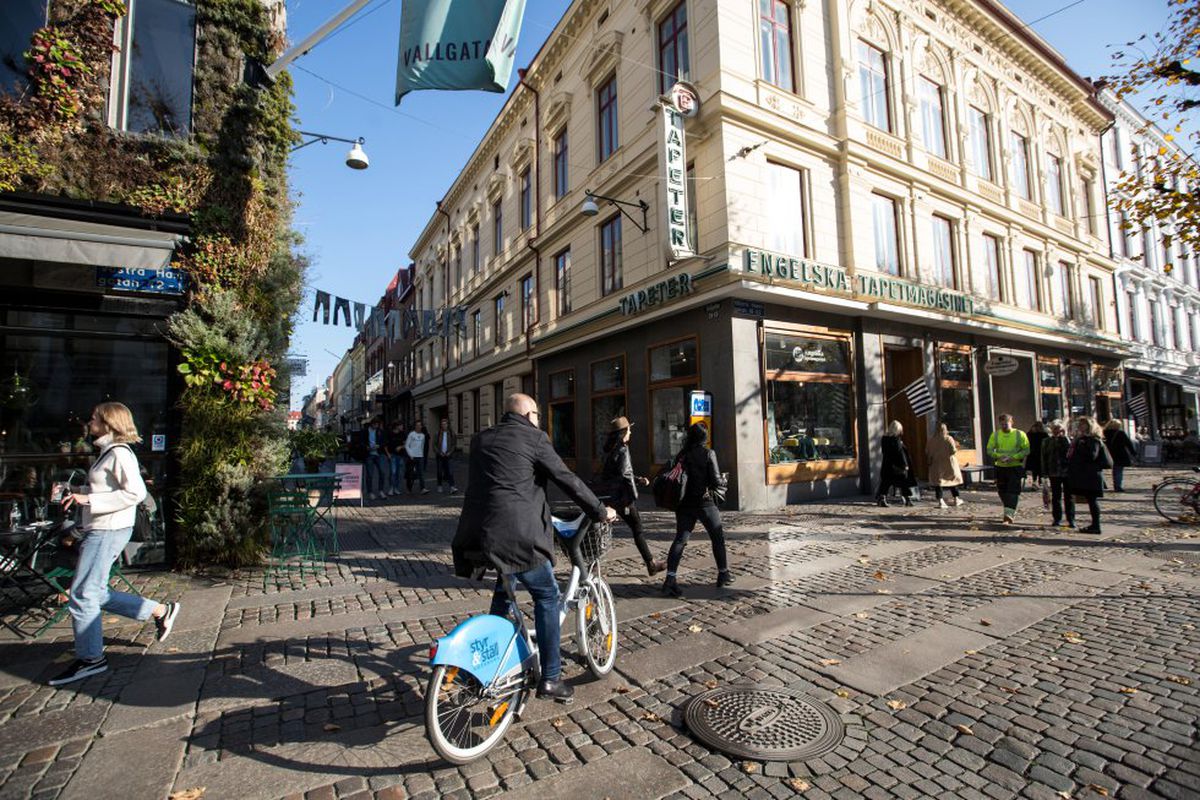
The era of abundant and cheap oil has allowed our society to undergo extraordinary urban and metropolitan expansion in recent decades. All this supported by a transport system designed to travel long distances at high speeds. Our cities quickly filled with large avenues and streets with several lanes, while they were clogged with cars. Between circulation and parking, we have devoted 80% of public space to them —cars.
This era has ended. Once the production peak has been surpassed — actually, extraction — of oil, the energy and materials crisis points to a horizon in which we will not be able to move by car with the frequency and insouciance to which we have become accustomed. We simply won’t have the energy for it. Using renewable sources, it will not be enough for us to maintain motorized mobility at its current levels, since these were possible thanks to abundant and cheap fossil energy that we will no longer have. In addition to the fact that a significant part of this renewable energy should have been channeled towards the maintenance of industrial activity and the habitability and comfort conditions of our homes, for example. The transport sector is necessarily going to contract, by hook or by crook.
In short, it is urgent to plan what we are going to do with our cities, because they will no longer be like before. We must bet on a compact urbanism and recover the neighborhood scale, mixing uses and functions so as not to have to go too far to satisfy our daily needs (go to work, to the place of study, to do the shopping, etc.). The city of 15 minutes in which Paris, Barcelona, Vitoria, Pontevedra, etc. are working.
Short distances make it possible to put people at the center, since walking is the protagonist, along with mobility by bicycle. It implies redesigning the public space and giving ourselves a new road hierarchy in which the car has logically lost its current hegemony. Maximizing the possibilities of non-motorized mobility (on foot and by bicycle) also implies putting more green in the city, since we will have to equip ourselves with shady sidewalks, squares, green corridors, etc.
And there will continue to be cars, but less than now, many of these will be for shared use. We do not have to see it as a painful deprivation, on the contrary, it will be one of the great levers to move towards more livable, healthy and resilient cities in the context of climate change in which we are immersed. We will enjoy fewer traffic jams and accidents, better public space, cleaner air, and a revitalization of local commerce and life in the neighborhoods. Along with urban greenery, the “production” (read transformation) of renewable energy or the circular economy, non-motorized mobility (on foot and by bicycle) must be part of a territorial strategy for adaptation to climate change. And from this urban and territorial strategy in the face of climate change, a new city model must emerge.
That is why it is essential to make a virtue of this need, to immediately put our hands to work, since this horizon of energy and material scarcity, climate crisis and urban and territorial reconfiguration is already here and we cannot avoid it.
The energy and materials crisis point to a horizon in which we will not be able to move by car with the frequency and carelessness to which we have become accustomed.
To generate a common vision around the possibilities of non-motorized mobility, or active mobility, a group of organizations, both public and private, have launched a public-private collaboration process to identify the main levers of change and lines of action to maximize this mobility and generate more livable, healthy cities with better public space, which places people at the center of the new model. The results of this work will be made available in a document that we will call the Active Mobility Manifesto and that will be available to all agents in the sector to help them better guide their policies and actions.
The collaboration process that we have begun is consistent with the Safe, Sustainable and Connected Mobility Strategy and the Bicycle Strategy, both promoted by the Ministry of Transport, Mobility and Urban Agenda (MITMA). We are not going against the Administration or the Government, but quite the opposite: we want to help and contribute. Our purpose, in fact, is to specify lines of action and make it easier for town halls to better focus their local policies.
Co-responsibility, commitment and the mobilization of citizens are fundamental aspects for us to get going and set up a new city and mobility model that responds to an urban and territorial strategy in accordance with the times of climate emergency that we are experiencing.