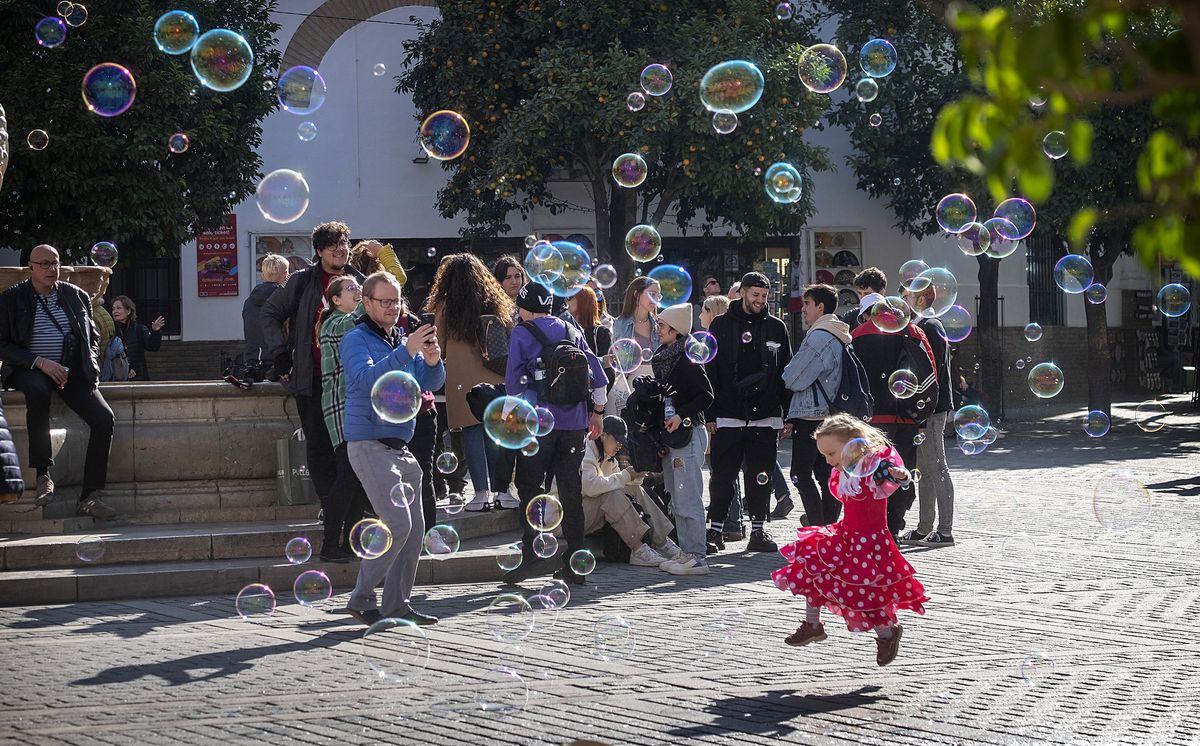
Data such as those that certify that Seville has the district with the most tourist pressure in Spain, the well-known neighborhood of Santa Cruz, where six out of ten accommodations are lodging for travelers (according to the report published by Exceltur last November), and with The consequent reduction in public services for residents has led the Andalusian city council to take another step in its tourism management policies, which have earned it the title of European Capital of Smart Tourism 2023 from the European Commission.
As explained by the mayor of Seville, Antonio Munoz, in the forum The paradigm shift towards sustainable tourism, held this Tuesday, December 13 and organized by El Viajero, the travel section of EL PAIS, in collaboration with the Seville City Office ( Seville City Hall), “sustainable tourism has to be compatible with the daily life of the neighbors”. “If before the hoteliers and hoteliers, travel agencies and other companies in the industry sat at the work tables in the tourism sector, now in Seville we are also going to sit the neighbors, who have to live with the tourist activity and we cannot put the neighbor against the tourist, but getting them to live together and integrate”.
Munoz assured that they are already working, in collaboration with private companies, on a series of digital transformations to have tools that visitors can benefit from, but also the local citizen: “Technology is inserted in our day to day, We just have to incorporate it into our decision-making when we think about enjoying the city: going to a restaurant or visiting a museum, thus avoiding a barrier being raised between the Sevillian and the tourist. Because of our way of being, because of how we occupy public space, it is already done in a very natural way, but more steps must be taken,” said the mayor of the PSOE in relation to the incorporation of new applications that can warn of congestion in the busiest areas of Seville, and others that help, for example,
But beyond the classic offer, the capital of Seville aspires to attract, more than just tourists, visitors, talents and companies that come to stay: “Seville is a medium-sized city that aspires to take the lead over the current large metropolises, to make tourist activity compatible with other economic sectors, developing a green economy, never far from sustainability, and with an eye on the decarbonization of the economy and digital transformation”.
The mayor of Seville Antonio Munoz, at the meeting on Tuesday, December 13. Alejandro Ruesga
In this regard, he recalled that the city has the largest technological and scientific park in Spain, with an annual turnover of 3,000 million euros; and factories such as the Heineken brewery, which has incorporated the first industrial plant with solar thermal technology to heat barley; or about 200 km of bike lanes. “Beyond tourism, this city from an industrial point of view is a spearhead in innovation,” he added.
One city, four visions
To demonstrate that “tourism is not a watertight compartment with the rest of the city’s economies”, the forum organized by EL PAIS also had a round table after the mayor’s intervention in which representatives of this new associated economy participated. to the national and international projection of Seville. They contributed their vision Silvia Aviles, director of TIS-Tourism Innovation Summit, an international congress that brings together more than 6,000 professionals from the sector in the Andalusian city; Marcus Cooper, Olympic canoeist, gold in Rio 2016 and silver medal in Tokyo 2020, that the winter season makes this city his training destination; Gervasio Iglesias, film producer behind which are multi-award-winning films such as La isla minima, Grupo 7, The man with a thousand faces or, most recently, Model 77; and Enrique Fernandez, president of Fernandez y Roche, a company rooted in Seville since the 19th century that makes the hats that can be seen on heads all over the planet, from Ascot races to ultra-Orthodox Jewish communities from Jerusalem to New York.
As a focus of attraction for visitors, Iglesias recognized that the cinema exerts an enormous traction engine. The vast majority of his films are located in Seville. “If you want to tell something universal, tell it from the local. It was always our premise. Shooting even in the least typical city, in the most disadvantaged neighborhoods, which gives us an idea of how polyhedral Seville is and that it supports many types of stories, from heritage films to period films to the most social cinema”. This is a feeling of greatness, added the producer and also director, “that encourages people to get to know the city, because, in addition, they have come closer to it thanks to a story that they have been told and they have liked it.”
From left to right, Elisabet Sans, responsible for ‘El Viajero’; Olympic canoeist Marcus Cooper; Enrique Fernandez, president of Fernandez and Roche; the film producer and director Gervasio Iglesias, and Silvia Aviles, director of the TIS-Tourism Innovation Summit, last Tuesday during the meeting in Seville. Alejandro Ruesga
For the elite athlete Marcus Cooper, a native of Palma (Mallorca), Seville has become a magnet for international athletes. “We are not only Spaniards who spend the winter training here, but many other international teams, Olympic medalists, who come. The Guadalquivir has become an international rowing venue. For us it is a way to get together with athletes from other countries to train. The ease that the city offers us also helps: there is a plus in performance”.
The paradigmatic case of Enrique Fernandez, from Fernandez and Roche, also explains why Seville is known beyond its borders beyond its clichés and its spring festivals. His hat shop, founded in 1885, was born at a time when the use of hats was a fashion spread throughout Europe. With its decline, he understood that “the survival of this company should be based on the search for a market where fashion was not the most influential.” As a result, and with only one physical store —located in the central Rosario street— their hats have been exported all over the world, their flagship product being the head covering worn by Orthodox Jews. Even so, “after 140 years, we do not plan to move from Seville.”
Lastly, Silvia Aviles, director of the TIS-Tourism Innovation Summit, assured that “coming to Seville was a meaningful opportunity for all the work well done in terms of smart tourism that has been done in recent years. But also a bet for the future. It is a city of sensations, a city that vibrates and that is why people want to return”.
All these experiences confirm that tourism in the 21st century faces challenges such as the digital transformation of the sector, the creation of new infrastructures to favor new forms of mobility, the attraction of investment and talent, and the search for solutions to end with areas saturated by tourism.