The old National Highway 340 has disappeared as it passes through Estepona (Malaga, 71,925 inhabitants). The four lanes of Avenida España have been transformed into a wide space for walking with dozens of trees, palm trees and thousands of small plants.
There is a bike lane and space to walk next to the beach. “It’s wonderful,” says Elena Prieto, who moved her fashion store to the new coastal area in November, two months after the promenade opened. It is the project that puts the icing on the cake of an ambitious plan developed by the City Council, which has pedestrianized 21 kilometers of streets. Initiative that has attracted hotels, tourists and luxury residential projects that allow Estepona to resemble Marbella. Also in the price of housing, which has doubled in less than a decade.
Pedestrianization ―and its periodic traffic jams around the center― is one of the main arguments that Estepona has used to attract tourists and, at the same time, retain population. It’s not bad. On one side, more than 400,000 travelers —65% foreigners— have visited the city so far this year, already exceeding the figures for 2019, according to the National Institute of Statistics. The town is the fourth most profitable destination in Spain, with an average income per available room of 166 euros, according to a recent Exceltur report. Its profitability is only behind Ibiza, Sant Josep de Sa Talaia and its neighbor Marbella, and is 102% more than in 2019, the last pre-pandemic year. Then there were 20% fewer hotel beds, which today amount to 8,340. On the other side, if the view extends a little further back, there is another revealing fact.
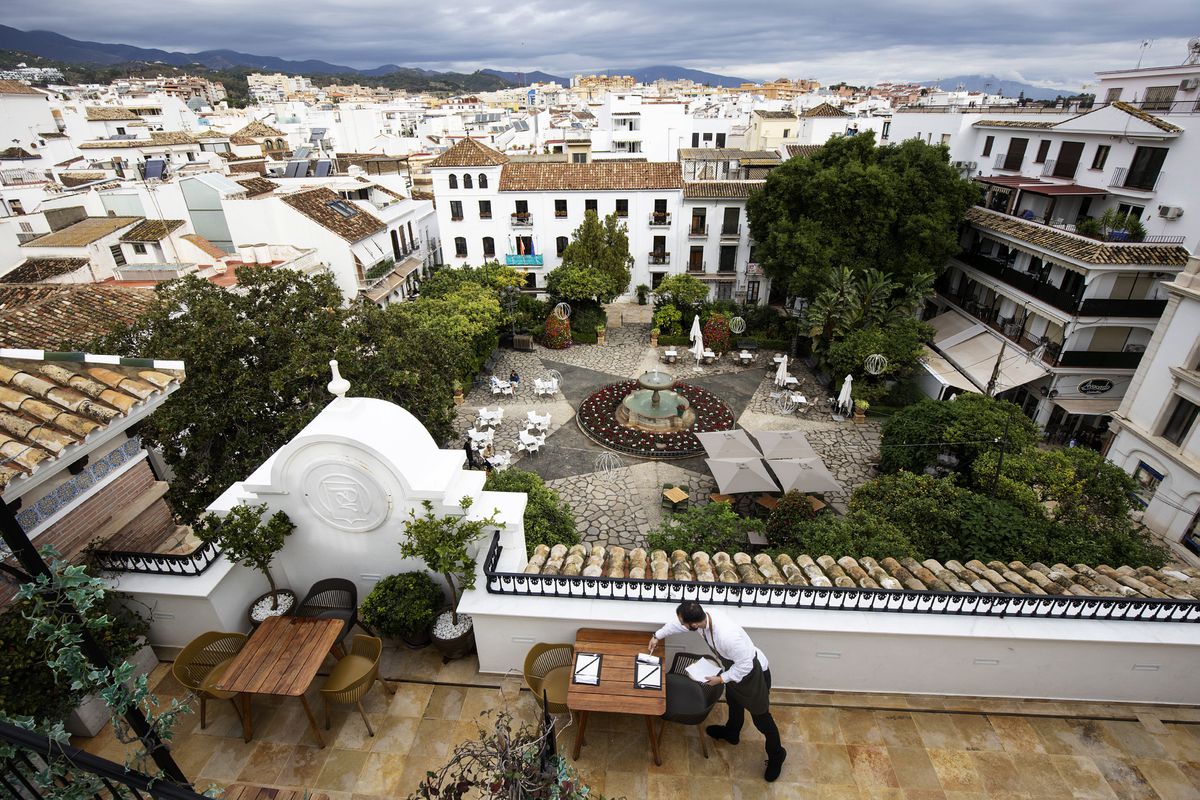
Estepona convinces both with a unique combination. It has managed to recover the air of a fishing village in the historic center while, near the beaches, tourist resorts and exclusive villas grow. With hardly any traffic, the number of people who, on any weekday, walk or cycle or scooter through the center of the city, with 130 streets and squares —including the one with the controversial slide— totaling 21 kilometers for pedestrians, is surprising. Hundreds of facades are decorated with thousands of pots. There are flowers in every corner of the municipality: flowerbeds, gazebos, flower beds, bars. According to municipal accounts, there are more than a million wearing permanently. That is why the slogan “Estepona, garden of the Costa del Sol” was created.
The public initiative has created a friendly city and the private one has followed it. If a decade ago there was no hotel in the historic center, today there are 16. One of them is El Pilar, with 36 rooms and four restaurants in the colorful Plaza de las Flores. It opened in 2021 and this year it maintains an average occupancy rate of 78%. “Estepona is growing and you have to be here,” says Javier Gonzalez, director of the hotel managed by the Silken chain, which will soon open another very close, the Maravilla Palace. “Customers celebrate both the authenticity of Estepona and its beaches. And now everything is accompanied by cultural initiatives, sports and a gastronomic awakening”, adds Juan Manuel Galan, director of the Elba hotel, with 204 rooms and almost two decades of history.
So much so that great fortunes have settled in the area. The investment of the Pacha Group in the new Laguna Village complex, where it intends to develop a project similar to Lio Ibiza, is an example, although it is not exempt from environmental criticism. The commitment of the Mosh Group, strong in Marbella, to open the Nido Beach beach bar in Estepona is another. Meanwhile, the Emare project has built 28 villas with a price starting at 3.4 million euros in the El Velerin neighborhood, where there are other luxurious plans such as the Velaya development. Nearby, the machines work to build 140 exclusive apartments in the Ayana area. “There we have already sold seven,” says Jimmy Widen, from the real estate agency 3SA Estate, who believes that Estepona is the place where luxury residential developments will grow the most in the coming years on the Costa del Sol.
Gone are the years in which the Independent Liberal Group (GIL), of Jesus Gil, and later the Astapa case made the town synonymous with corruption. The arrival of Jose Maria Garcia Urbano (PP) in 2011 ushered in a period of stability. In his years at the head of the City Council, the councilor has promoted pedestrianization, but also the new orchid garden, the recovery of the old castle or the construction of an athletics stadium, an auditorium and 22 kilometers of coastal path. Even the hospital was paid by the City Council due to the ineffectiveness of the Junta de Andalucia. The municipal debt has gone from 300 to 50 million.
“Value history, beautify its streets and generate open urban environments: the key is to make the city for the residents,” said Garcia Urbano – with a reputation for being a good manager – this Monday after meeting with Baroness Carmen Thyssen, who will give him funds from his collection to be exhibited at El Mirador del Carmen. It is the new cultural space that Estepona hopes to open in March 2023, two months before the elections. Everything indicates that it will devastate again. In 2019 he obtained 69.04% of the votes, 21 of 25 councillors.
The remaining four are from the PSOE, an opposition that, according to the Audiovisual Council of Andalusia, is silenced. The entity stressed in 2020 that the time dedicated on local television to the government team was 91% of the total and only 9% to the socialist mayors. The PSOE periodically denounces that the city has a housing problem and, in fact, the price per square meter grew by 18% in the last year and has doubled since 2014, according to Idealista. He also criticizes the lack of cleanliness and the “disastrous management” of the municipal staff. Garcia Urbano “is more dedicated to speculation and the construction of houses with high purchasing power,” denounced the provincial secretary of the Socialists, Daniel Perez, a few weeks ago. Black spots, for now, covered by the brightness of the new Estepona.