

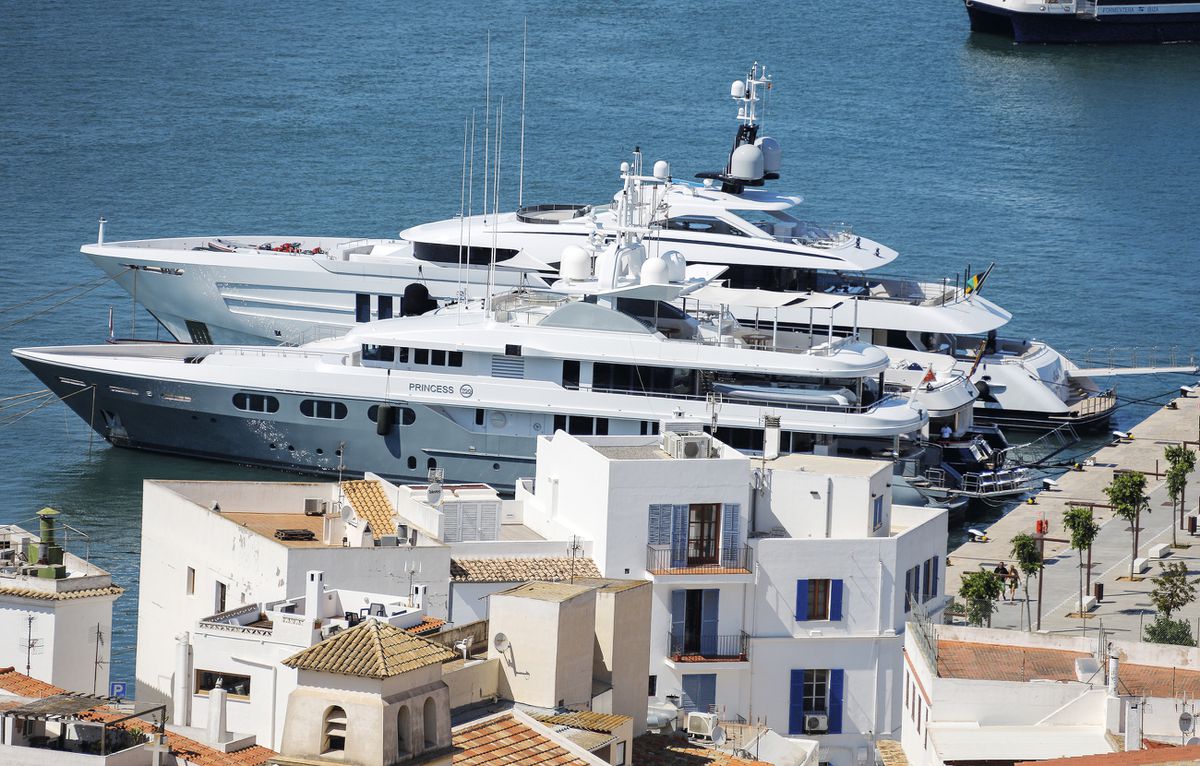
Nacho Lezcano lived in the Buddhist center of Madrid, felt an almost allergic detachment towards material, led an austere life. Suddenly, he found himself catapulted into the epicenter of luxury and glitz in Europe. And he began to sing.
He had been hired at Lio, a mix of restaurant, nightclub and cabaret nestled in the port of Ibiza, with views of the bay and the Dalt Vila, a place where the champagne is uncorked with joy, fanfare and sparklers. Its average consumption per table is between 500 and 600 euros and things can get out of hand: if you choose well (or poorly), a bottle can reach the price of an average flat in a provincial capital. In 2019, a customer purchased a 30-litre Armand de Brignac Brut Gold for €130,000. It is normal to see celebrities like Ronaldo, Messi, Anne Hathaway, Justin Bieber… The list is as long as the wait. One of the most expensive restaurants in Ibiza is also one of the most requested.
“It was a big contrast. Never in my life had I witnessed such a level of waste, it was amazing ”, Lezcano now describes. This 36-year-old Argentine singer especially remembers one night. His director had warned them that after the musical number there would be a small surprise: the directors of a Spanish fashion group wanted to give something to the president of the company. The lights dimmed, Nessun Dorma began to play, and a large yacht lit up across the waters of the harbor. “He took a walk around the bay and held up behind the scenes,” recalls Lezcano. “That was the gift. One yeit. Me, who came from living 11 years in Madrid, a fairly simple life. That left me in shock.”
It is said that Ibiza has many faces. One is hedonistic and party-loving, so noisy that sometimes it silences the rest: according to a report carried out for the Universitat de les Illes Balears in 2019, the nightclub business represents 35% of the island’s gross domestic product and occupies the same percentage of its workers. But there are others. One is the relaxed, wild and secluded to the north, where a capillary network of dusty paths lead to little-crowded coves, to small towns with whitewashed houses. Then there is hippie and alternative Ibiza, which began to take shape in the 1970s, when bad kids from good families landed on the island. The locals called them the peluts.
That Ibiza has reached our days recycled into a boho-chic collection and it is easy to identify it in spiritual retreats and yoga classes throughout the island. There is still one more Ibiza. A true and costumbrist, which is not born from the sweetened idea that tourists bring from abroad; one that worries about making ends meet in the city with the most expensive home in Spain; which remains there when the others go into hibernation until the next season. And it is this that, when the tourist closure is closed each year, begins to wonder where the island is going.
These different versions of the same place are the pieces of a puzzle that are difficult to put together. Their lives unfold in parallel, often without touching, perhaps coinciding in the queue at the Mercadona or in the saturated Can Misses hospital, to the southeast. But they are all affected in the same way by the impact of money, in enormous amounts. Ibiza has opted for extreme luxury, a conscious and strategic commitment. One that threatens to engulf everything else.
According to a study carried out by Fotocasa, the square meter in the Balearic Islands has reached its historical maximum, both for rent and for sale. This is sold at 3,184 euros (in Spain, the average is 1,988) and is rented for almost 14 (11.3 in the national average). According to a study carried out by El Diario de Ibiza, the island is the third most expensive destination in the Mediterranean, behind only Saint-Tropez and Capri. The report places the average price on a weekend in June at 400 euros per night. This greatly limits the options for workers who go there for the season. Dozens of them are forced to camp in the woods, where they settle until they are evicted by the police. It is a situation that is repeated every year, but each time it is more serious and more common.
In 2017, one of the busiest beaches to watch the sunset, Benirras, ran out of its mythical drums. The improvised musicians who played during the sunset realized that the nearby restaurants were cashing in on the show and demanded their share. They started a hippie strike to get the hoteliers to pay them a weekly salary. No agreement was disclosed to the press, but two weeks later the drums sounded again while the mojitos (12 euros a glass) and the champagne sangria (110 euros a pitcher) flowed. The rhythm does not stop in Ibiza.
This year the absence of Russian tourists has been noted. They have replaced it, yes, Dutch (they have increased their accommodation by 20%) and Belgians (10%). Some, to take advantage of teleworking, extend their stays. The rooms “have managed to match the collections of the year prior to the pandemic,” according to Jose Luis Benitez, representative of the group of the main nightclubs on the island, announced. But this is only a partial indication. It’s been a while since luxury here changed the dance floor for the gym.
The Daily Mail recently defined Ibiza as “a Notting Hill on the sea”, ironically narrating its mutation from a clubbers’ paradise to a magnet for the type of bohemian and healthy rich in the London neighborhood: “It is said that there are more yoga instructors per mile square in Ibiza than in any other vacation spot in the world”, can be read in the article.
You don’t always sleep well in this Xanadu of well-being. when we spoke with Carlos Martorell, for example, he didn’t sleep a wink. He woke her up to a Lamborghini roaring under his house in the wee hours of the morning. More than sleeplessness, the absurd bothers him. “I understand that you come here with a 4×4, but with a Lamborghini? Really? ”, He asks the phone more to himself than to his interlocutor. The motorway that connects Ibiza and San Antonio has a small section, about 3,000 meters, where you can reach 120 kilometers per hour, the only place where such speed is allowed. The rest are back roads and dusty roads. “There is a lot of new rich, a lot of tacky billionaires,” laments this classic public relations man from the place, who has lived here since the sixties, when he was a friend of Andy Warhol. “I am glad that to this island, who was very poor, do well. But the prices are getting out of hand. This year the number of private planes, of very expensive restaurants is crazy… ”, she says.
Martorell is quite critical of this type of luxury, especially for someone who is an ambassador of Ibiza Luxury Destination, a title granted by the association of Ibizan businessmen to encourage this type of visitor. This dichotomy is shared by many inhabitants: they know that tourism, especially that of the wealthy, has lifted Ibiza out of poverty, but they are not unaware of its excesses. Being the playground of the 1% has consequences for the remaining 99. Not all are positive.
If a seismograph of luxury existed, it would probably place the epicenter of this profitable earthquake in a VIP area. These have become the true economic engine of the clubs and provide a continuous and frantic pumping of cash to the tills. The price for accessing these places varies according to the discotheque or the session. “You can leave between 5,000 and 50,000 euros per table, depending on how attractive the party is,” adds Sheila Martinez, who in recent years has worked as a VIP room manager at a well-known club on the island. “There are exorbitant prices. Many times customers stay for a couple of hours and leave the bottles whole, ”she points out.
Martinez knows the side effects of this type of tourism. “Everyone wants to earn money in the few months that the season lasts and on many occasions it becomes ridiculous,” he admits. Still, he makes for a positive reading. Life in Ibiza is expensive, but fun, and sometimes offers little surprises. Martinez has been here for ten years, ever since he moved from his native Barcelona, and he continues to speak of Ibiza with the reverence with which one speaks of a newfound love.
It is something common to many interviewees. They speak of The Island in capital letters, in an almost anthropomorphic way. As if Ibiza had its own personality; a mystique, kind and special. The story that is made of her is romanticized, sweetened by the mind of the adopted Ibizans. “When you arrive, Ibiza embraces you or expels you”, they repeat like a mantra. However, this sentence is based on an erroneous premise. Many Ibizans do not come to the island, they are born on it. And it is not Ibiza that throws them out, but speculation.
This is what happened to Alicia Hurtado, a 36-year-old Ibizan, who emigrated to the US in 2021. Luxury, for her, is access to basic services and in Ibiza this is not always easy. “My mother is sick and she has to go to the doctor in Palma, because the oncologists here don’t even know how many times they have changed,” she explains by phone. The Health Area of the Pitiusas would need 69 more doctors, according to the opposition, from the PP. And the problem is extensible to other areas of the administration. Political formation ensures that in 2002 5,324 state employees worked in Ibiza compared to the current 4,000. Unions such as Jupol (police), SIMEBAL (doctors) and CSIF (civil servants in general) have supported these complaints and organized various demonstrations last September.
Hurtado, a teacher by profession, confirms it: “Many squares were left deserted.” Tired of a place surrendered to tourism, she now returns to her native island only in summer to see it becoming more and more saturated, more expensive. More luxurious. “From outside it gives the feeling that it is raped every season, it is blown up by cars, people and speculation.” And this feeling only stopped with the pandemic.
Juan Serra knows a while about these necessities. In the long past decade on the island it has specialized in the management of exclusive villas. Very exclusive. They can cost 90,000 euros a week, and there are cakes to get them. “The richest people in the world fight to come here,” he says. Models, singers, businessmen, actors… Serra’s contact list could go through the index of the magazine Hello! but discretion is on the rise in his world. Serra tells stories, but does not give names. Stories of 600-euro bottles of champagne that are used to play at getting wet; gargantuan meals that go to waste, with shellfish overcooked in the sun and meat full of flies. He talks about municipal police looking for an extra doing private security at parties.
Serra narrates these scenes with administrative coldness. “It is what feeds us to get us through the rest of the year. Otherwise we couldn’t”, he explains. The height of summer allows many to survive the quiet of winter. All the Balearic Islands are experiencing a boom, but while Mallorca has an asset in urban tourism and cycling for the cold months, in Ibiza and Formentera there is hardly a place to hang on when the last disco closes. The Socio-environmental Observatory of Menorca presented this summer the 4 Islands report that compares the situation of Fuerteventura, Lanzarote, Ibiza and Menorca. The conclusion was clear: Ibiza is the one that suffers the greatest seasonal imbalances.
Ironically, these imbalances are what bring a certain balance to Ibiza, a constantly changing place of extremes. Its different faces may be crossed by a common evil, but it is this, in the end, that keeps them afloat. The criticisms are legitimate but not unanimous. They make up a chorus of dissonant voices, but they all repeat the same refrain: the island is changing. Basically it has been changing since it became fashionable, in the sixties. Fashion seems not to have passed, but it is reinventing itself, attracting a new type of public with each mutation. First it was the hippies, then the clubbers. In recent years, the mega-rich have joined. None of the previous groups has been totally replaced, none has wanted to leave Ibiza. Rather, they have been scattered around the island, coexisting in a tangential way, creating small social archipelagos. Groups that shape the different faces and masks of Ibiza, an island that embraces and expels. Sometimes at the same time.


